15 December 2009

Native American homes

Wigwam Homes

Wigwams (or wetus) are Native American houses used by Algonquian Indians in the woodland regions. Wigwam is the word for "house" in the Abenaki tribe, and wetu is the word for "house" in the Wampanoag tribe. Sometimes they are also known as birchbark houses. Wigwams are small houses, usually 8-10 feet tall. Wigwams are made of wooden frames which are covered with woven mats and sheets of birchbark. The frame can be shaped like a dome, like a cone, or like a rectangle with an arched roof. Once the birchbark is in place, ropes or strips of wood are wrapped around the wigwam to hold the bark in place. Here are some pictures of a woman building a wigwam.


cone-shaped * dome-shaped * rectangular shape * wigwam frame

Wigwams are good houses for people who stay in the same place for months at a time. Most Algonquian Indians lived together in settled villages during the farming season, but during the winter, each family group would move to their own hunting camp. Wigwams are not portable, but they are small and easy to build. Woodland Indian families could build new wigwams every year when they set up their winter camps.

Longhouses

Longhouses are Native American homes used by the Iroquois tribes and some of their Algonquian neighbors. They are built similarly to wigwams, with pole frames and elm bark covering. The main difference is that longhouses are much, much larger than wigwams. Longhouses could be 150 feet long, 20 feet wide, and 20 feet high. Inside the longhouse, raised platforms created a second story, which was used for sleeping space. Mats and wood screens divided the longhouse into separate rooms. Each longhouse housed an entire clan-- as many as 60 people!


sketch of a longhouse * longhouse cutaway * a longhouse today

Longhouses are good homes for people who intend to stay in the same place for a long time. A longhouse is large and takes a lot of time to build and decorate. The Iroquois were farming people who lived in permanent villages. Iroquois men sometimes built wigwams for themselves when they were going on hunting trips, but women might live in the same longhouse their whole life.

epees

Tepees (also spelled Teepees or Tipis) are tent-like American Indian houses used by Plains tribes. A tepee is made of a cone-shaped wooden frame with a covering of buffalo hide. Like modern tents, tepees are carefully designed to set up and break down quickly. As a tribe moved from place to place, each family would bring their tipi poles and hide tent along with them. Originally, tepees were about 12 feet high, but once the Plains Indian tribes acquired horses, they began building them twice as high.


Indian tepee photograph * picture of tepees being set up

Tepees are good houses for people who are always on the move. Plains Indians migrated frequently to follow the movements of the buffalo herds. An entire Plains Indian village could have their tepees packed up and ready to move within an hour. There were fewer trees on the Great Plains than in the Woodlands, so it was important for Plains tribes to carry their long poles with them whenever they traveled instead of trying to find new ones each time they moved.

Grass Houses

Grass houses are American Indian homes used in the Southern Plains by tribes such as the Caddos. They resemble large wigwams but are made with different materials. Grass houses are made with a wooden frame bent into a beehive shape and thatched with long prairie grass. These were large buildings, sometimes more than 40 feet tall.


Wichita grass house *Caddo grass house * construction

Grass houses are good homes for people in a warm climate. In the northern plains, winters are too cold to make homes out of prairie grass. But in the southern plains of Texas, houses like these were comfortable for the people who used them.

Wattle and Daub Houses

Wattle and daub houses (also known as asi, the Cherokee word for them) are Native American houses used by southeastern tribes. Wattle and daub houses are made by weaving rivercane, wood, and vines into a frame, then coating the frame with plaster. The roof was either thatched with grass or shingled with bark.


rivercane frame * plastered and thatched

Wattle and daub houses are permanent structures that take a lot of effort to build. Like longhouses, they are good homes for agricultural people who intended to stay in one place, like the Cherokees and Creeks. Making wattle and daub houses requires a fairly warm climate to dry the plaster.

Chickees

Chickees (also known as chickee huts, stilt houses or platform dwellings) are Native American homes used primarily in Florida by tribes like the Seminole Indians. Chickee houses consisted of thick posts supporting a thatched roof and a flat wooden platform raised several feet off the ground. They did not have any walls. During rainstorms, Florida Indians would lash tarps made of hide or cloth to the chickee frame to keep themselves dry, but most of the time, the sides of the structure were left open.


drawing of a chickee * Seminole chickee

Chickees are good homes for people living in a hot, swampy climate. The long posts keep the house from sinking into marshy earth, and raising the floor of the hut off the ground keeps swamp animals like snakes out of the house. Walls or permanent house coverings are not necessary in a tropical climate where it never gets cold.

Adobe Houses

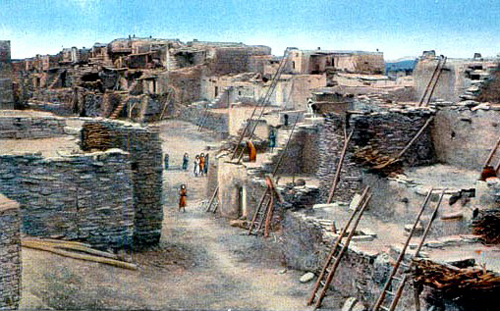
Adobe houses (also known as pueblos) are Native American house complexes used by the Pueblo Indians of the Southwest. Adobe pueblos are modular, multi-story houses made of adobe (clay and straw baked into hard bricks) or of large stones cemented together with adobe. Each adobe unit is home to one family, like a modern apartment. The whole structure, which can contain dozens of units, is often home to an entire extended clan.


Pueblo Indian houses * Adobe cliff dwellings * Hopi Mesa pueblos

Adobe houses are good homes to build in a warm, dry climate where adobe can be easily mixed and dried. These are homes for farming people who have no need to move their village to a new location. In fact, some Pueblo people have been living in the same adobe house complex, such as Sky City, for dozens of generations.

Earthen Houses

Earthen house is a general term referring to several types of Native American homes including Navajo hogans, Sioux earth lodges, subarctic sod houses, and Native American pit houses of the West Coast and Plateau. Earthen houses made by different tribes had different designs, but all were semi-subterranean dwellings -- basement-like living spaces dug from the earth, with a domed mound built over the top (usually a wooden frame covered with earth or reeds.)


Pawnee earth lodge * Navajo hogan * Alaskan sod house

Earthern houses are good for people who want permanent homes and live in an area that is not forested. (It's difficult work to excavate underground homes in areas with many tree roots!) Living partially underground has several benefits, especially in harsh climates-- the earth offers natural protection from wind and strong weather.

gloos

Igloos (or Iglu) are snow houses used by the Inuit (Eskimos) of northern Canada. Not all Inuit people used igloos -- some built sod houses instead, using whale bones instead of wooden poles for a frame. Like a sod house, the igloo is dome-shaped and slightly excavated, but it is built from the snow, with large blocks of ice set in a spiral pattern and packed with snow to form the dome.


Inuit (Eskimo) igloo * Building an igloo * Inside an igloo

Igloos are good houses for the polar region, where the earth is frozen, the snow cover is deep, and there are few trees. Snow is a good insulator, and dense blocks of ice offer good protection against the arctic winds.

Brush Shelters

Brush shelters (including wickiups, lean-tos, gowa, etc.) are temporary Native American dwellings used by many tribes. Brush shelters are typically very small, like a camping tent. People cannot usually stand up straight inside brush lodges -- they are only used for sleeping in. A brush shelter is made of a simple wooden frame covered with brush (branches, leaves, and grass.) The frame can be cone-shaped, with one side left open as a door, or tent-shaped, with both ends left open.


conical frame * conical wickiup * tent-shaped frame * tent-shaped brush lodge

Most Native Americans only made a brush shelter when they were out camping in the wilderness. But some migratory tribes who lived in warm dry climates, such as the Apache tribes, built brush shelters as homes on a regular basis. They can be assembled quickly from materials that are easy to find in the environment, so people who build villages of brush shelters can move around freely without having to drag teepee poles.

www.native-languages.org


14 December 2009

The Destruction of Indian America


The arrival of the Europeans in the New World was the beginning of the end of Indian life. Many settlers thought they were superior to the Indians and tried to force them to take on their way of life.
Land became the main problem between the Europeans and the Indians. Settlers wanted land for farming and mining. As time went on, more and more Indians were forced off their land as new settlers arrived and travelled west.
At first settlers and Indians were friendly towards each other but when they started to protect their land fighting broke out.
In 1830 a law was passed that allowed the government to move Indian tribes to the land west of the Mississippi.
When gold was found in California in the 1850s settlers rushed west as quickly as possible and destroyed the land that the Indians depended on for hunting and fishing.
At the beginning of the 20th century the American government started putting Indian tribes on reservations in the western part of the United States. Later on, American Indians were allowed to vote and the government tried to integrate them into society.
Native Americans Today
About 2.5 million Native Americans live in the USA today. The biggest tribes are the Cherokee, Chippewa, Navajo and Sioux. About a third of the Indians in the US live on reservations. The rest live in cities or towns.
Indian culture is still preserved on reservations. Here, Indians practice old traditions. However, they are worried that their traditions will disappear because more and more Indians are being integrated into society.
Today, Native Americans are better off than they were at the beginning of the 20th century. They get better education; many go to high school and some to college. Many Native Americans work as lawyers, doctors or have other important jobs, like working for government companies.
Some tribes get money from tourism or selling handicrafts. In 1988 the government al-lowed casinos and other gambling operations on reservations. Other tribes earn money from taxes on oil or gas that is produced on their land.
Even though life has improved , Native Americans still face many problems in today’s America. Unemployment on reservations is about 50%. The income of an Indian family is much lower than that of a white family. Most Indians are badly paid and are unskilled workers. Suicide rates are also higher than in other places. Some Indians try to reduce their problems by drinking alcohol and taking drugs.

(English across the curriculum)

WORDS
arrival = the coming
better off = to have more money and live a better life than before
depend on = need very much
destroy = zerstören
disappear = verschwinden
drugs = Drogen
face = deal with
force = zwingen
gambling = Glückspiel
improve = get better
income = the money you get when you have a job
handicrafts = Handwerksgegenstände
integrate = to become part of a group of people
law = Gesetz
lawyer = Rechtsanwalt
mining = Bergbau
practice = ausüben, leben nach
preserve = erhalten
protect = to keep someone or something safe = schützen
reduce = to make something smaller
reservation = an area of land that the government gave Indians to live on
rush = to go very quickly
settler = someone who goes to live in a place where not many people have lived before
society = Gesellschaft
suicide rate = the number of people who kill themselves
superior = better than
tax = money that the government gets from selling things
tribe = a group of people who have the same way of life and the same language. They are ruled by a leader
unemployment = people who do not have a job
unskilled worker= Hilfsarbeiter
vote = wählen


Ordering Exercise
Fill in the gaps
Text Building Exercise

Source:
Herderschule

12 December 2009

Grammar: Passive Voice


Passive Voice
Aktiv: Nick bought a big cake.
Passiv: A big cake was bought by Nick.


Tenses

Present: is/are bought
Past: was/were bought
Present Perfect : has/have been bought
Past Perfect T: had been bought
Future: will be bought
Conditional: would be bought

Bildung: "be" + Past Participle

Wir verwenden das Aktiv, wenn die handelnde Person im Vordergrund steht:
The policeman arrested Big Joe.

Wir verwenden das Passiv, wenn das Geschehen oder der Betroffene im Vordergrund steht:
Big Joe was arrested.

Der Verursacher wird nicht erwähnt, wenn er unwichtig ist (they, a man, somebody)
Lunch is served from 12 to 2.

Will man den Verursacher nennen, hängt man ein -by Objekt an.
The letters are brought by the milkman, because the postman is afraid of our dog.

Im Englischen wird das Passiv oft bei Gebrauchsanweisungen und Beschreibungen verwendet (deutsch: man)

How paper chains are made: First the paper is cut, then it is folded, .....


Passive Infinitive


Bildung: "be" + Past Participle
She must write the invitations. The invitations must be written.
She need not type the letter. The letter need not be typed.
He may give her a reward. She may be given a ...
He might leave the gate open. The gate might be left open.
He must not touch the silver. The silver must not be touched.
You can use my pen. My pen can be used.
They could warn the thief. The thief could be warned.
You shall turn off the light. The light shall be turned .....
You should do it at once. It should be done at ...
You ought to tell her about it. She ought to be told ....

Sätze mit 2 Objekten
She gave the children some sweets.
Some sweets were given to the children.
The children were given some sweets.

She gave them some sweets.
Some sweets were given to them.
They were given some sweets.

Bei Sätzen mit zwei Objekten können wir immer zwei Passivsätze bilden, d. h. jedes der beiden Objekte kann zum Subjekt eines Passivsatzes werden.
Im Englischen wird häufiger das "personal object" (the children, them) zum Subjekt des Passivsatzes gemacht (= personal passive)

Ein Personal Pronoun steht dann als Subjekt natürlich im 1. Fall:

She gave me a necklace. She gave you a necklace.
I was given ..... You were given.....
She gave her ............ She gave him............
She was given ............. He was given.......
She gave us ................... She gave them..........
We were given ......... They were given...

Bei folgenden Verben findest du häufig ein Personal Passive:
bring, give, lend, offer, pay, promise, teach, tell, sell, send, show


Print it out and stick it in your Grammar-Book. And don't forget to study!

30 November 2009

Christmas Songs

Last Christmas


I want a hippopotamus for Christmas


I want a hippopotamus for Christmas
Only a hippopotamus will do
Don't want a doll, no dinky Tinker Toy
I want a hippopotamus to play with and enjoy

I want a hippopotamus for Christmas
I don't think Santa Claus will mind, do you?
He won't have to use our dirty chimney flue
Just bring him through the front door,
that's the easy thing to do

I can see me now on Christmas morning,
creeping down the stairs
Oh what joy and what surprise
when I open up my eyes
to see a hippo hero standing there

I want a hippopotamus for Christmas
Only a hippopotamus will do
No crocodiles, no rhinoceroses
I only like hippopotamuses
And hippopotamuses like me too

Mom says the hippo would eat me up, but then
Teacher says a hippo is a vegeterian

There's lots of room for him in our two-car garage
I'd feed him there and wash him there and give him his massage

I'm dreaming of a White Christmas


I'm dreaming of a white Christmas
Just like the ones I used to know
Where the treetops glisten,
and children listen
To hear sleigh bells in the snow

I'm dreaming of a white Christmas
With every Christmas card I write
May your days be merry and bright
And may all your Christmases be white

I'm dreaming of a white Christmas
With every Christmas card I write
May your days be merry and bright
And may all your Christmases be white

I can see me now on Christmas morning,
creeping down the stairs
Oh what joy and what surprise
when I open up my eyes
to see a hippo hero standing there

I want a hippopotamus for Christmas
Only a hippopotamus will do
No crocodiles or rhinoceroseses
I only like hippopotamuseses
And hippopotamuses like me too!

Mary's Boy Child


The little Drummer Boy


Come they told me, pa rum pum pum pum
A new born King to see, pa rum pum pum pum
Our finest gifts we bring, pa rum pum pum pum
To lay before the King, pa rum pum pum pum,
rum pum pum pum, rum pum pum pum,

So to honor Him, pa rum pum pum pum,
When we come.

Little Baby, pa rum pum pum pum
I am a poor boy too, pa rum pum pum pum
I have no gift to bring, pa rum pum pum pum
That's fit to give the King, pa rum pum pum pum,
rum pum pum pum, rum pum pum pum,

Shall I play for you, pa rum pum pum pum,
On my drum?

Mary nodded, pa rum pum pum pum
The ox and lamb kept time, pa rum pum pum pum
I played my drum for Him, pa rum pum pum pum
I played my best for Him, pa rum pum pum pum,
rum pum pum pum, rum pum pum pum,

Then He smiled at me, pa rum pum pum pum
Me and my drum.


Winter Wonderland


Sleigh bells ring, are you listening,
In the lane, snow is glistening
A beautiful sight,
We're happy tonight.
Walking in a winter wonderland.

Gone away is the bluebird,
Here to stay is a new bird
He sings a love song,
As we go along,
Walking in a winter wonderland.

In the meadow we can build a snowman,
Then pretend that he is Parson Brown

He'll say: Are you married?
We'll say: No man,
But you can do the job
When you're in town.

Later on, we'll conspire,
As we dream by the fire
To face unafraid,
The plans that we've made,
Walking in a winter wonderland.

In the meadow we can build a snowman,
And pretend that he's a circus clown
We'll have lots of fun with mister snowman,
Until the other kids knock him down.

When it snows, ain't it thrilling,
Though your nose gets a chilling
We'll frolic and play, the Eskimo way,
Walking in a winter wonderland.


Mr Duncan's Christmas Message

26 November 2009

Thinkquest - Native Americans of South Dakota

Photo by South Dakota Tourism


Click here and find out some interesting things about Native Americans.


library.thinkquest.com

The Indigeous People of North America


Photo: earthstarspiritualcenter.org


When European explorers arrived in America in 1492 they found around 2 million indigenous people living there.
The Europeans mistakenly called them Indians, thinking they had landed in the Indies in the Far East of Asia.
The explorer Christopher Columbus made this famous mistake.
The term “Indians” stuck with the people who lived there despite not even coming from India!!!.
How rude!!
These 'Indians' belonged to at least 300 different tribes and spoke over 2,000 different languages.
Famous examples of these indigenous tribes are

_ the Cheyenne

_ the Blackfoot

_ the Comanche

_ the Sioux


Each tribe spoke a separate language, and their houses, clothes and entertainment differed. However, they all followed a similar life based on hunting and farming.
These indigenous people were related to the peoples of north eastern Asia.
It is thought that their ancestors crossed a land bridge linking Siberia to Alaska around 30,000 BC.
There was gradual movement south to the Great Plains of (the yet to be
called) America.

www.schoolhistory.co.uk

3 November 2009

Thanksgiving


Listen to the text and fill in the blanks with words from the drop-down menu.

My amazing Thanksgiving. By filling in words, you can create your own Thanksgiving story.


Listen to the song Turkey Blues and now do this exercise.
(Click:Play this game)

The story of Thanksgiving Day. Click here.


Thanksgiving voyage
is a gap-fill-in-exercise.


Source:
pagesperso-orange.fr
quia.com
lve.scola.ac-paris.fr
eduplace.com

Exercise: Mixed Tenses


Exercise 1: Simple Present - Present Progressive
Exercise 2: Simple Past - Past Progressive
Exercise 3: Present Perfect - Simple/Progressive
Exercise 4: Will-Future - Going-to-Future
Exercise 5: Mixed Tenses
Exercise 6: Mixed Tenses
Exercise 7: Present Perfect - Simple/Progressive
Exercise 8: Present Perfect - Simple/Progressive - Past
Exercise 9: A quiz on English Tenses
Exercise 10: Mixed Tenses
Exercise 11: Mixed Present and Past Tenses
Exercise 12: Mixed Tenses
Exercise 13: Mixed Tenses
Exercise 14: Mixed Tenses
Exercise 15: Mixed Present and Past Tenses
Exercise 16: Mixed Tenses
Exercise 17 : Mixed Tenses in Context - James Cook
Exercise 18: Mixed Tenses
Exercise 19: Mixed Present and Past Tenses
Exercise 20: Mixed Present and Past Tenses


Source:
rsg.rothenburg.de

englisch-hilfen.de
nonstopenglish.com
english-4u.de
testyourenglish.net
sussex.ac.uk
ilv.ucl.ac.be
ego4u.com
personales.ya.com
angoloktato.hu

Irregular Comparison

good better best
bad worse worst
much more most uncountable nouns
many more most countable nouns
little less least
little smaller smallest


Some ajdectives have two possible forms of comparison.

common commoner / more common commonest / most common
likely likelier / more likely likeliest / most likely
pleasant pleasanter / more pleasant pleasantest / most pleasant
polite politer / more polite politest / most polite
simple simpler / more simple simplest / most simple
stupid stupider / more stupid stupidest / most stupid
subtle subtler / more subtle subtlest
sure surer / more sure surest / most sure


Difference in meaning with adjectives

far farther farthest distance
further furthest distance or
time
late later latest
latter x
x last
old older oldest people and things
elder eldest people (family)
near nearer nearest distance
x next order

Exercise 1 with "near, late, bad, good, far, old
Exercise 2 Fill in the missing words
Exercise 3 Fill in the missing words
Exercise 4 on Comparison of Adjectives (as...as)
Exercise 5 on the text "London"
Exercise 6 late, last, later, latter, latest
Exercise 7 Comparison mixed

Source:
hsgunskirchen

englisch-hilfen.de
eg4u
rong-chang.com

24 October 2009

The History of Halloween

Watch the video to find out about the origin of Halloween


Here is another video telling the history of Halloween in words.

22 October 2009